

Best Corporate Bank Accounts With Unlimited Virtual Cards: 2026 Review
The corporate card market consolidated hard this year. Capital One completed its acquisition of Brex on April 7, 2026, paying roughly $2.56 billion in cash plus 10.6 million shares of Capital One stock, per Capital One's 8-K filing with the SEC. Slash sits on the other side of that consolidation, issuing unlimited virtual corporate cards with up to 2% cashback to more than 10,000 businesses.¹
The timing matters because "unlimited virtual cards" has become a checkbox that not every provider ticks the same way. Some cap issuance outright: Relay, for example, limits businesses to 50 debit cards. Others issue debit cards and call them corporate cards, which means no cashback and no charge-card structure behind them.
Cards remain the dominant payment instrument by volume, accounting for over three quarters of the 236.6 billion noncash payments US consumers and businesses made in 2024, according to the Federal Reserve's 2025 triennial payments study released in July 2026. Here's which corporate cards deliver unlimited virtual issuance, and what each one costs to get it.
Key Takeaways
- Slash issues unlimited virtual corporate cards on both the Free and Pro plans, with physical cards available for any team member who needs one.
- Not every "virtual card" program is unlimited: Relay caps issuance at 50 debit cards, per its own product page.
- Cashback rates range from 1% to 2% among the cards on this list, and Ramp sets its rate per customer.
- Card groups and per-vendor limits matter as much as raw card count once a business is issuing cards at scale.
- Eligibility thresholds, not features, disqualify most businesses from the leading corporate cards.
Why Unlimited Virtual Card Issuance Is a Real Requirement, Not a Vanity Feature
At first glance, "unlimited" sounds like marketing. In practice, three workflows break the moment issuance is capped.
- One card per vendor: A SaaS subscription on its own virtual card, locked to that merchant with a hard monthly limit, can't be silently upgraded, double-billed, or renewed after cancellation. If the vendor tries to charge more than the limit or a different merchant name hits the card, the transaction declines. Fifty vendors means fifty cards, each with its own policy.
- One card per ad account or traffic source: Performance marketers need clean attribution and the ability to freeze a single source without touching the rest. Merchant restrictions keep an ad-platform card from being used anywhere else.
- One card per client or project: Agencies passing through media spend need per-client isolation for both reconciliation and billing. Grouping those cards under a client budget gives the finance team one number to watch instead of dozens.
A 100-person company running all three patterns is issuing hundreds of cards. That's why the cap is the first thing to check.
Evaluate on four criteria.
- True issuance limit: Whether virtual cards are actually unlimited, and whether physical cards draw from the same pool.
- Spend control granularity: Per-transaction limits, per-vendor limits, merchant category restrictions, and the ability to freeze a card instantly.
- Cashback rate: Whether it's published on a pricing page or set per customer after approval.
- Eligibility: Minimum cash balances, entity type, and where the business has to operate.
1. Slash Visa® Platinum Card: Unlimited Virtual Cards on Every Plan, Up to 2% Cashback
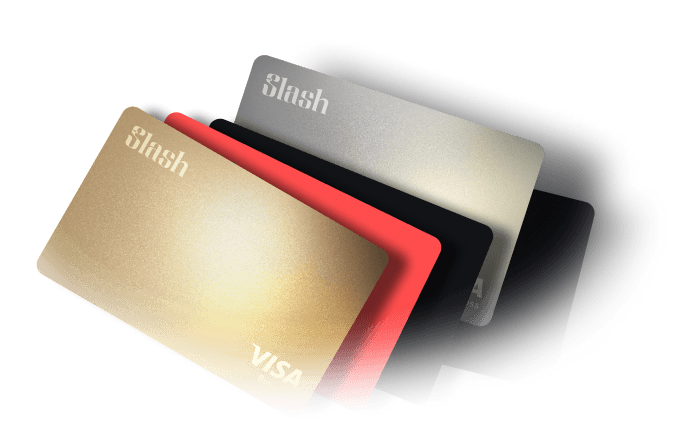
Slash issues unlimited virtual corporate charge cards, regardless of whether you’re on the $0 Free plan or the $25 Pro plan. Physical cards are also available for any team member who needs one, and they’re ordered from the same dashboard. That's the cleanest answer to the issuance question on this list.
The Slash Visa® Platinum Card is a corporate charge card issued by Column N.A. on the Visa network. Card charges settle in full from your Slash cash account at the end of each business day, so there's no interest, no carried balance, and no monthly bill to track.
Spend Controls and Reporting
- Per-card rules: Spend limits, per-transaction limits, and merchant restrictions on every virtual card, so a card scoped to one vendor can't be used anywhere else.
- Card groups: Department-level or client-level budgets, such as $500K per month for ads, with every card in the group rolling up to a single limit.
- Permissions: Granular control over who can create, view, freeze, or edit cards, and who has to approve changes.
- Receipt capture: When a purchase needs a receipt, Twin, Slash's AI financial assistant, texts the cardholder for a photo and matches it to the transaction using OCR.
- Cards on demand: Ask Twin to issue a virtual card for a specific vendor with a set monthly limit, freeze a card, or adjust a limit, subject to the same permissions as the dashboard.
- Reporting: Spend by merchant, card, card group, or accounting category, with transactions visible in real time.
- Accounting sync: Two-way accounting integrations with QuickBooks Online, Xero, NetSuite, and Sage Intacct, with transactions categorized and coded before they reach the ledger.
Slash customers have earned $50.3 million in cashback to date. Sobhan Nejad, Co-Founder and COO of Bland AI, a Slash customer, cited "ease of use, how quickly we could onboard, [and] the cashback component" as the reasons the team chose the platform.


What It Costs
The Free plan is $0 per month and includes unlimited virtual cards, up to 1.5% cashback, and FDIC insurance up to $150 million through Column N.A.'s insured cash sweep network.² Domestic wires are $6, same-day ACH is $1, and outgoing FedNow or RTP transfers are $5.
Pro is $25 per month, raises cashback to up to 2%, and takes domestic wires, same-day ACH, and FedNow or RTP to $0. Both plans are listed on the Slash pricing page rather than quoted per customer, so you know the rate before you apply.
2. Ramp: A Fit for Expense Automation
Ramp pairs its card with a spend-management layer that handles a lot of the policy work automatically. Preset controls can block out-of-policy spend before it happens, receipt capture is prompted at swipe, and the policy engine reviews every expense and surfaces exceptions.
Unlimited physical and virtual Visa cards are included, with no personal credit check and no personal guarantee, according to NerdWallet's June 2026 review of the card.
The rewards picture is less clear. Ramp advertises up to 1.5% cashback on card spend, and NerdWallet lists the rate as 1% to 1.5%, set per customer by Ramp. Bankrate notes that Ramp moved from a flat 1.5% to a creditworthiness-based rate in May 2024, so you won't know your number until after approval.
Eligibility is the harder gate. Per NerdWallet, Ramp requires at least $25,000 in cash in a US business bank account and is available only to corporations, LLCs, limited partnerships, and nonprofits with most operations and spend in the US. Sole proprietorships and unregistered businesses are excluded.
3. Brex: Now Inside Capital One
Brex combines a corporate card, spend management software, and a business account in one platform, with unlimited virtual cards and expense automation that handles categorization and receipt matching.
As of April 7, 2026, Brex operates as part of Capital One, so the platform now sits inside a major regulated bank rather than an independent fintech. Brex CEO Pedro Franceschi continues to run the business.
That changes the evaluation. Underwriting models, reward structures, and compliance policies all sit with a new owner, and how those settle is still playing out. If you're evaluating Brex in 2026, ask directly about the roadmap and pricing commitments for your contract term rather than assuming continuity.
4. Mercury IO: Flat Rewards, Deposit-Backed Limits
Mercury's IO card offers a flat 1.5% cashback on all settled purchases, no annual fee, no personal guarantee, and no personal credit check. Virtual and physical cards can be issued instantly to team members with built-in controls, and Mercury doesn't publish a cap on virtual card count.
The IO Card is issued by Patriot Bank, Member FDIC, and requires a Mercury account. Mercury reports to major credit bureaus, so it builds business credit.
Like most corporate charge cards, the IO limit is tied to the cash held on the platform. Per Mercury's help center, the IO balance can't exceed cash deposits held with Mercury, and the introductory limit is typically up to $5,000 with daily repayment. At $15,000 or more in total balances, businesses can qualify for higher limits and choose 30-day terms. Companies with steady balances will find that predictable, while those that regularly sweep cash out for inventory or media buys should model how their limit moves through the month.
Side-by-Side Comparison
How to Choose a Corporate Card With Unlimited Virtual Cards
Work through this in order.
- Check eligibility first: A $25,000 minimum cash requirement disqualifies you before features matter. Slash business banking accounts are open to US-registered LLCs, C-Corps, and S-Corps; Slash, Ramp, and Brex all exclude sole proprietorships.
- Confirm the card type: A charge card with cashback and a debit card with none behave very differently at scale.
- Ask for the published rate:"Up to" with per-customer discretion is not the same as a rate listed on a pricing page.
- Test the control granularity: Per-vendor limits and merchant restrictions, not just a global monthly cap.
- Understand the repayment cadence: Slash settles daily, Ramp settles per statement period, and Mercury offers 30-day terms above $15,000 in balances. Daily settlement means no interest and no carried balance, and it works best for teams that keep their operating account funded.
For non-US teams, the path runs through the Slash Global Card issued against a Global USD Account rather than a standard US corporate card.
Putting Unlimited Virtual Cards to Work in Slash
Unlimited issuance is only useful if the cards carry policy. Here's what a per-vendor card program looks like inside Slash from day one.
- Create the card: Issue a virtual card from the dashboard, or ask Twin from Slack: "Issue a virtual card for AWS with a $5,000 monthly limit." The card is live in seconds and can be added to Apple Pay, Google Pay, or Samsung Pay.
- Lock it down: Set a monthly spend limit, a per-transaction ceiling, and a merchant restriction so the card only works at the vendor it was created for. If the vendor's billing changes or the number leaks, the transaction declines.
- Group it: Assign the card to a group such as Marketing, Client A, or Infrastructure. Each group has its own budget, and the finance team watches one number per group instead of one per card.
- Let Twin handle receipts: When a purchase needs documentation, the cardholder gets a text, replies with a photo, and OCR matches it to the transaction. No expense report required.
- Sync it to the ledger: Transactions flow to QuickBooks Online, Xero, NetSuite, or Sage Intacct already categorized, with the receipt attached, so month-end close doesn't start with a spreadsheet.
- Earn on every card: Every virtual card in every group earns the plan's cashback rate, up to 1.5% on Free and up to 2% on Pro, with no bonus categories to track.
None of that is gated behind a plan tier. The Free plan ships with unlimited virtual cards, card groups, merchant restrictions, and the integrations, which is why the per-vendor pattern works for a three-person team as well as a 300-person one.
Conclusion
The corporate card market in 2026 has fewer independent players and more ambiguity in published rewards rates than it did a year ago. That makes the two questions worth asking simpler: is the issuance limit real, and is the cashback rate published?
For finance teams building per-vendor and per-campaign card discipline, those two answers will predict how the tool performs at scale better than any feature list.
Talk to the Slash team about structuring card groups and spend controls before your next audit cycle.
Apply in less than 10 minutes today
Join the 10,000+ businesses already using Slash.
FAQs
1. What is the best corporate card with unlimited virtual cards in 2026?
The best corporate card with unlimited virtual cards in 2026 is the Slash Visa® Platinum Card, which issues unlimited virtual cards on both the $0 Free plan and the $25 Pro plan with up to 2% cashback. Ramp is an alternative for teams prioritizing expense automation, though it requires $25,000 in a US business bank account.
Virtual Business Credit Cards: How They Work + Best Options for 2026

2. Do corporate cards really offer unlimited virtual cards?
Some corporate cards really offer unlimited virtual cards and some do not. Slash, Ramp, and Brex all issue unlimited virtual cards, while Relay caps issuance at 50 debit cards per its product page, so it is worth confirming the published limit and the card type before committing.
What Are the Benefits of Virtual Cards? Tips & Insights

3. How much cashback do corporate cards pay in 2026?
Corporate cards on this list pay between 1% and 2% cashback in 2026. Slash pays up to 2% on card spend, Mercury's IO card pays a flat 1.5%, and Ramp advertises up to 1.5% with NerdWallet listing the rate as 1% to 1.5% depending on the customer.
How Does Cash Back Work? Choosing the Right Credit Card Rewards Program

6 Best Cash Back Business Credit Cards for your Company
4. Does a corporate card with unlimited virtual cards require a personal guarantee?
A corporate card with unlimited virtual cards generally does not require a personal guarantee. The Slash Card, Ramp, Brex, and Mercury IO all issue without a personal guarantee, though eligibility criteria such as minimum cash balances or entity type still apply.
Business Credit Cards With No Personal Guarantee: Top Picks and How To Apply
5. Can a non-US business get a corporate card with unlimited virtual cards?
A non-US business can get corporate cards through the Slash Global Card, a physical and virtual Visa card linked to a Global USD Account for businesses in 130+ countries, earning 1.1% cashback on eligible purchases. Several US-focused providers require most operations and corporate spend to be based in the United States.
Open a US Business Bank Account as a Non-Resident: Requirements and Benefits


